
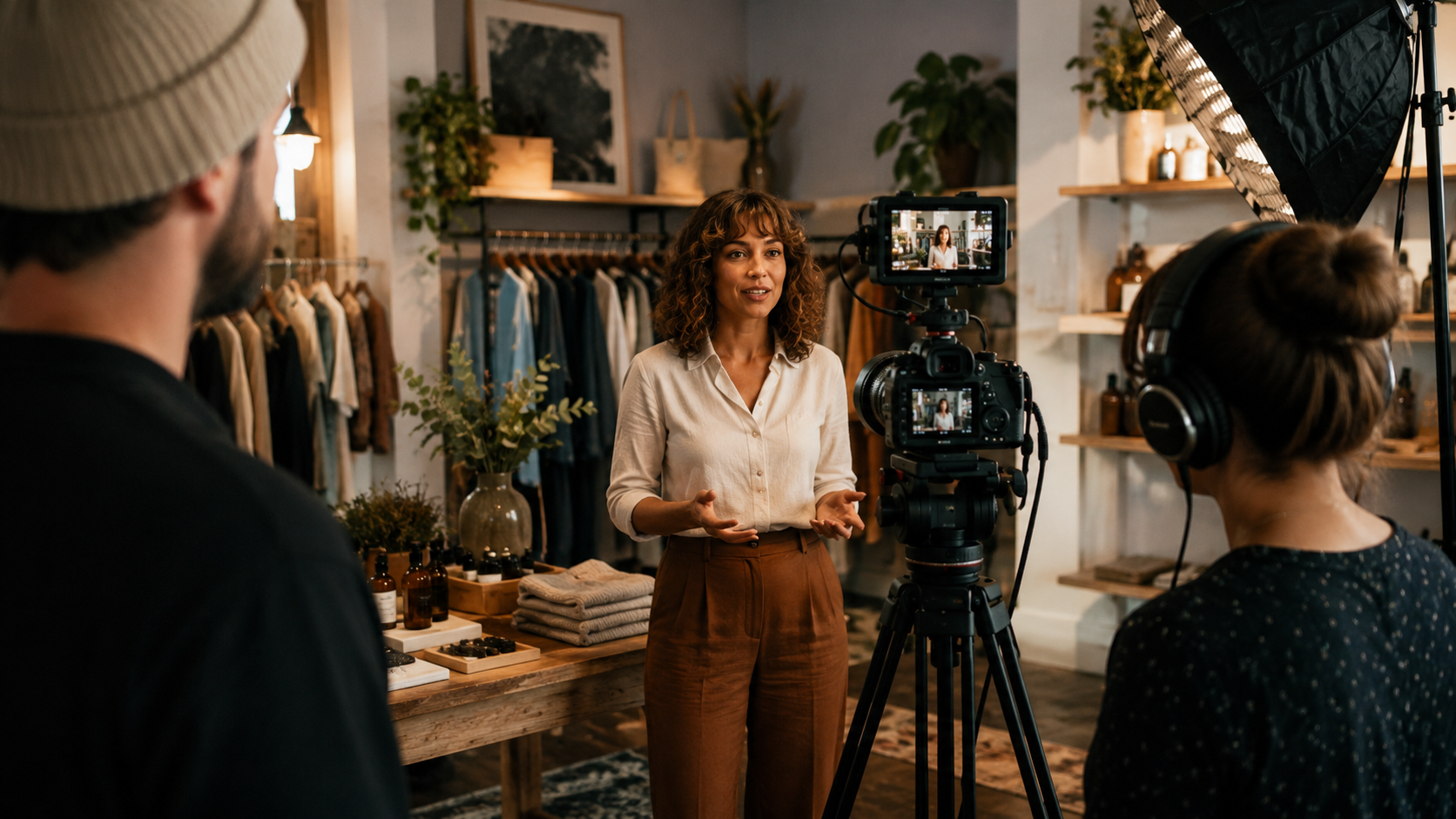
…Here’s the thing.
Small business video should not feel like a perfume commercial.
Unless you sell perfume.
Even then, maybe calm down.
Most small businesses don’t need a glossy, overproduced mini-movie where someone walks through a warehouse in slow motion while a voiceover says, “We believe in tomorrow.”
Tomorrow is fine.
But can the customer understand what you do today?
That’s the real question.
When someone searches for the best video production agencies for small business US 2026, I don’t think they’re usually hunting for the fanciest crew in the country. They’re trying to find people who can make the business look credible, explain the offer clearly, and not turn the whole project into a second full-time job.
Because small business life is already noisy.
The owner is approving payroll.
The marketing person is updating the website, fixing a typo in an email blast, ordering banners for an event, and somehow also “handling social.”
There’s probably a logo file that only exists as a screenshot.
There’s definitely a folder called “final assets” that is, in fact, not final.
I’ve opened those folders. I have felt the tiny spiritual damage.
So the right production agency can’t just show up with cameras and vibes.
They need to bring structure.
They need to ask useful questions.
They need to help turn one shoot day into actual marketing material: homepage content, social clips, product demos, paid ad versions, testimonial cuts, maybe a loop for a trade show booth if you’re doing that whole standing-on-concrete-for-eight-hours thing.
Fun? Debatable.
Useful? Very.
That’s why this list is not about who can make the most dramatic reel.
It’s about agencies that understand small business video has to earn its keep.
Pretty is nice.
Useful is better.
Best Video Production Agencies for Small Business in the US
1. Sparkhouse
Sparkhouse is a strong fit for small businesses that want polished video without the whole thing feeling intimidating.
Based in Orange County, California, Sparkhouse works across brand videos, product videos, commercials, social videos, animation, training videos, how-to content, photography, and website content.
That range helps because small business video needs change fast.
One month it’s a product launch.
Next month it’s a testimonial.
Then it’s a homepage refresh because the current video has a haircut in it that belongs to another economic era.
No judgment.
We all have archives.
What I like about Sparkhouse in this category is that the team can support the full path: concept, scripting, planning, production, editing, revisions, and delivery.
That is a relief for small businesses that do not have a full creative department waiting in the hallway with storyboards.
Sparkhouse also makes sense in the best video production agencies for small business US 2025 conversation because their work can be planned around actual use.
A product video can support an ecommerce page.
A founder video can warm up the homepage.
A testimonial can help sales follow-up.
A short cutdown can become a paid ad.
A few clips can feed social without making the business reinvent content every morning before coffee.
That is the practical win.
Not just one nice export sitting in Google Drive like a trophy no one visits.
Video should move.
It should go places.
It should help someone understand, trust, click, buy, book, or remember.
If it doesn’t, why did everyone wake up early for the shoot?
2. Lemonlight
Lemonlight is worth considering for small businesses that want video production to feel organized and less mysterious.
That sounds basic, but basic is underrated.
A lot of production gets fuzzy fast. The timeline gets soft. The deliverables get confusing. Someone asks about captions, usage rights, or vertical versions, and suddenly everybody is looking at the floor.
No thanks.
Lemonlight is known for marketing-focused video work: testimonials, brand videos, product content, commercials, and social videos. For small businesses, that kind of structure can be helpful because the goal is usually not to create art in a vacuum.
The goal is to make something that supports marketing.
A better landing page.
A stronger ad.
A clearer product story.
A trust-building testimonial.
They fit this list of the best video production agencies for small business US 2025 because smaller teams often need a process that is clear, calm, and direct.
Not boring.
Just not chaotic.
There is a difference.
3. Bottle Rocket Media
Bottle Rocket Media feels useful for small businesses that need a mix of storytelling and practical deliverables.
Promotional videos, explainers, event content, motion graphics, company stories, social cuts, that kind of thing.
This matters because one project often has to feed several channels.
A founder interview might become a homepage video, a LinkedIn clip, a sales follow-up asset, and a few quote-based social cuts.
An event recap might become next year’s promo, sponsor content, internal hype, and maybe a recruiting piece.
A product video might need a clean hero version and a faster ad version.
The footage has jobs to do.
Plural.
Bottle Rocket Media makes sense when a business wants to avoid the “we made one video and now what?” problem.
Because that problem is real.
It creeps in after the excitement fades and someone says, “Should we post this somewhere?”
Yes.
Hopefully several somewheres.
That should’ve been planned before the camera rolled, but hey, growth opportunity.
4. Demo Duck
Demo Duck is where I’d send someone when the business is hard to explain without grabbing a marker and slowly destroying a whiteboard.
You know that business.
The thing works.
The customer does need it.
The founder can explain it beautifully in person.
Then somehow the homepage says, “We help organizations unlock smarter outcomes.”
Come on.
What does it DO?
Demo Duck is good for explainers, animation, product stories, and mixed-media videos. That makes them useful for small businesses that need to translate a slightly complicated idea into something normal humans can understand.
Not investors.
Not your product team.
Normal tired humans who are checking your site between meetings and wondering if lunch is gonna be sad again.
A good explainer should feel like someone finally turned the lights on.
I’ve sat in rooms where a founder needed nine minutes to explain a product, then the right 75-second explainer made everyone go, “Oh. Wait. That’s actually simple.”
That moment is everything.
Demo Duck belongs in the best video production agencies for small business US 2025 conversation because some brands don’t need more drama.
They need the click.
The “ohhh, I get it now” click.
Tiny moment.
Big deal.
5. Kyro Digital
Kyro Digital makes sense when the video needs taste.
Not just information.
Taste.
And yes, that word can get dangerous fast.
Because someone says “premium,” then suddenly there’s a slow-motion shot of a founder touching a wall while a piano plays like we’re mourning the old version of the CRM.
Please don’t do that.
Still, feeling matters.
A lot.
For a lifestyle product, wellness brand, hospitality business, founder-led company, design-forward service, or anything where perception is part of the sale, the look of the video can start doing work before anyone fully understands the offer.
That is annoying, but true.
People judge fast.
Color, pacing, wardrobe, locations, lighting, music, the way a hand picks up a product, the way a room feels on camera, all of it sends signals.
Kyro Digital can be a good fit when the brand needs to feel more elevated, but not dead inside.
Because polished and lifeless are cousins, apparently.
And they visit often.
The trick is keeping the video stylish while still making it useful.
Mood is not the strategy.
Mood is seasoning.
Do not serve a bowl of seasoning.
6. True Film Production
True Film Production is a good option for small businesses that need something steady, polished, and business-friendly.
Not everything has to feel like a TikTok ad got into a fight with a PowerPoint deck.
Some businesses need a company overview.
A recruiting video.
A sales piece.
A customer story.
A conference video.
A clean “yes, we are real and competent” asset.
And honestly, there is nothing wrong with that.
Corporate video gets made fun of because a lot of it is… well.
You know.
Glass conference room.
Slow walking.
Person pointing at a laptop.
Someone saying “innovation” with the emotional range of printer paper.
But when corporate video is done well, it can help a small business look established without pretending to be massive.
That distinction matters.
A small business can look professional and still feel personal.
It can have clean lighting and still sound human.
It can have a polished edit without turning everyone into LinkedIn robots.
True Film Production fits when credibility is the job.
Not noise.
Not trends.
Credibility.
Underrated little word.
7. Anchour
Anchour is interesting because video is not their only lane.
They also work in branding and marketing, and sometimes that’s the bigger problem hiding under the video request.
I know. Rude twist.
A business says, “We need a video.”
But then you look closer and the message is all over the place.
The website says one thing.
The pitch deck says another.
The sales team explains it differently on calls.
Instagram is posting something from a separate universe.
And the logo folder?
A crime scene.
Eight files called “final.” Two are blurry. One is from 2016. Nobody knows why the black version has a drop shadow.
This is where an agency like Anchour can make sense.
If the video needs to connect to a bigger brand refresh, campaign, or messaging cleanup, you may not want a production-only partner. You may want someone who can zoom out and ask, “Wait, what are we actually saying here?”
That question can be painful.
It is also useful.
Anchour belongs in the best video production agencies for small business US 2025 list because a video should not be floating off by itself.
It should match the website.
It should match the ads.
It should match the sales story.
Basic? Yes.
Common? Absolutely not.
8. New Perspective Marketing
New Perspective Marketing is a strong fit for B2B small businesses, especially the ones that sell things people do not buy after one cute social post.
Manufacturing.
Cleantech.
Industrial services.
Specialty equipment.
Technical products.
B2B software.
The world of spec sheets, buyer committees, demos, procurement, and one person named Mark asking a question so specific everyone quietly respects and fears him.
There is always a Mark.
In B2B, video has to behave differently.
It might help a prospect understand the product before a sales call.
It might make a landing page less painful.
It might support a trade show booth.
It might make a complicated service feel less risky.
It might give the sales team something better to send than “just checking in.”
Please retire “just checking in,” by the way.
New Perspective Marketing makes sense because technical B2B content needs clarity without baby talk.
That is the balance.
Do not dumb it down.
Just make the door easier to open.
For some small businesses, that is the whole win.
9. Casual Films
Casual Films might not be the right fit for every small business.
Good.
Not every agency needs to be for everybody.
That’s how you end up with mush.
But for a growing small business that has a more serious communication need, they can be worth a look.
Brand films.
Recruiting videos.
Internal communications.
Training pieces.
Culture videos.
Bigger campaigns where the company needs to look like it has moved past “we filmed this in the conference room after lunch.”
At some point, the early scrappy stuff starts to feel too small.
The company has changed.
The team is bigger.
The clients are bigger.
The expectations are higher.
The old video with the outdated office wall and one employee who left three years ago?
Yeah.
It’s time.
Casual Films makes sense when the video needs to represent where the company is now, not where it was when everyone was still sharing one Dropbox login.
A strangely emotional milestone, honestly.
10. The Social Shepherd
The Social Shepherd is the social-first option I’d keep on this list.
And I mean social-first from the start.
Not “we shot a horizontal video and then cropped it vertically until the speaker looked like they were trapped in an elevator camera.”
No.
That is not social strategy.
That is salvage work.
Social-first video has different rules.
Hooks.
Captions.
Fast openings.
Vertical framing.
Creator-style pacing.
Paid social variations.
A reason for someone to stop scrolling when they are half paying attention, holding an iced coffee, and mentally avoiding one email they really need to answer.
A homepage video has room.
A social ad has seconds.
Different sport.
The Social Shepherd fits the best video production agencies for small business US 2025 conversation because small businesses using Instagram, TikTok, LinkedIn, YouTube Shorts, or paid social need content built for the feed.
Not rescued for the feed.
Rescued content usually looks rescued.
Like a bad haircut you’re pretending was intentional.
Why Small Businesses Should Invest in Professional Video Production
1. Building Trust With New Customers
Trust is not a bonus.
It is the whole front door.
Before someone books a call, buys the product, walks into the office, or asks for a quote, they’re doing that quiet little mental scan.
Do these people seem real?
Do they know what they’re doing?
Will I regret giving them my email address?
Video helps answer those questions faster than copy alone.
And yes, I love good copy. I will absolutely lose ten minutes debating one sentence on a homepage. It’s a sickness. But sometimes people need to see the person behind the business.
They need to hear tone.
They need to watch the product being used by actual hands, not just floating in a perfect white background like it has no earthly problems.
A good video can show the owner greeting a customer, the team packing orders, the technician explaining a service, the product being opened, the space feeling warm, clean, busy, calm, whatever the brand needs to communicate.
Not fake.
Just clearer.
That’s where the best video production agencies for small business US 2025 really matter. They should know how to make real people comfortable on camera without turning them into corporate mannequins.
Please no “Hi, I’m thrilled to introduce our innovative solution” face.
Nobody talks like that at lunch.
Let the business feel human.
A little awkwardness can even work, honestly. Not chaos. Not rambling for six minutes about “the journey.” But a small pause, a laugh, a slightly imperfect sentence?
That can make someone trust you more.
Funny how that works.
2. Explaining Products or Services More Clearly
Some businesses are blessed with simple explanations.
Tacos.
Yoga studio.
Dog wash.
Done.
Other businesses have to fight for clarity.
Maybe you sell a product people don’t understand until they see it in motion. Maybe your service has five steps. Maybe you’re in healthcare, SaaS, manufacturing, finance, home services, or another category where your value is obvious only after someone explains it with a screen share and three examples.
Then the website says, “We provide custom solutions for growing teams.”
Nooooo.
What do you actually do?
Video is great at cutting through that fog.
A product video can show size, texture, assembly, packaging, features, use cases, and little details people would otherwise miss.
A service video can walk someone through what happens before, during, and after they hire you.
An explainer can take a messy process and make it feel manageable.
A testimonial can do the beautiful thing marketing copy can’t do as well: let someone else say, “This worked for me.”
That matters.
People trust people faster than they trust claims from the company selling the thing. Shocking, I know. Someone alert the strategy department.
The point is not to make the business sound huge.
The point is to make the value easy to understand.
Because confused buyers do not usually convert.
They hesitate.
They open another tab.
They say they’ll “circle back,” which is basically business-speak for disappearing into the woods.
Clear beats clever more often than I want it to.
I hate admitting that, because clever is more fun. But clear pays rent.
3. Creating Better Website and Social Media Content
Your website is probably being judged before anyone talks to you.
Rude?
Yes.
True?
Also yes.
A strong video on a homepage, product page, landing page, or service page can make the whole business feel more alive. It gives people a faster read on your tone, your process, your quality, and your humans.
Not your “brand values” paragraph.
Your humans.
That matters for small businesses because personality is often part of the sale. People are not just buying the service. They’re buying the feeling that they picked the right people.
Then there’s social media.
Deep breath.
Small businesses are now expected to make Reels, Shorts, TikToks, LinkedIn clips, founder videos, customer stories, product demos, behind-the-scenes posts, paid ad cuts, event recaps, and probably a video for some random awareness day that nobody knew existed until the content calendar demanded it.
ARE YOU KIDDING ME.
That’s not a marketing plan. That’s a tiny unpaid newsroom.
This is where planning ahead saves everyone’s sanity.
If you already have the crew, lighting, location, product, customer, founder, or team on camera, please do not walk away with only one horizontal video.
Get the main video, yes.
But also capture vertical moments, quick answers to FAQs, product closeups, short hooks, alternate intros, a few clean b-roll passes, and maybe some behind-the-scenes clips that do not look like they were filmed from inside someone’s pocket.
I once watched a team try to crop a wide interview into a vertical social clip and the speaker’s face ended up floating on the edge of frame like a haunted doorbell camera.
Not ideal.
The best video production agencies for small business US 2025 should be asking where the footage needs to live before shoot day.
Website?
Instagram?
YouTube?
Paid ads?
Sales emails?
Trade show screen?
Each one changes how you shoot.
That conversation has to happen early, not after the edit is approved and someone suddenly says, “Can we get this in 9:16?”
That sentence has ended lives.
Okay, not lives.
But definitely afternoons.
4. Supporting Local Marketing and Paid Ads
Local marketing is partly about repetition.
Someone sees your name once and ignores it.
Then they see a customer talking about you.
Then they see your truck in the neighborhood.
Then your video ad pops up while they’re scrolling half-awake on the couch.
Then, two weeks later, they need the thing you sell.
Now you’re not a stranger.
That’s the game.
Video helps because it gives people something to recognize. A face. A storefront. A product in use. A clean before-and-after. A customer saying, “Yeah, they actually showed up on time.”
That last one is basically poetry in home services.
For paid ads, though, you have to be sharper.
A 90-second brand video may work beautifully on a homepage.
It might fall flat as a cold Instagram ad.
Different job.
Paid social needs a hook fast. Captions. Tight framing. Sound-off clarity. A clear next step. Maybe a few versions, because the first edit is not always the winner.
It also has to respect how people actually watch.
They’re in line at coffee.
They’re pretending to answer emails.
They’re standing in Target wondering why they came in for one thing and now have a cart full of tiny storage bins.
So the video has to get to the point.
Not rudely.
Just quickly.
This is why “we need a video” is too vague.
For what?
For whom?
Where will it run?
What should the viewer do after watching?
What happens if they only watch the first three seconds?
Annoying questions. Useful questions. The best kind, unfortunately.
5. Making the Brand Look More Professional
Scrappy content has a place.
I respect scrappy.
A quick phone video from the owner can sometimes outperform a polished ad because it feels immediate and real. No argument there.
But eventually, scrappy can start to cost you.
Bad audio makes people leave.
Bad lighting makes the product look cheaper.
A messy background makes the business look less organized than it is.
A weird crop can make a perfectly smart person look like they’re being interviewed from a security camera.
The business might be excellent.
The video just isn’t saying that.
Professional production helps close the gap between the quality of the business and the way the business appears online.
Cleaner sound.
Better lighting.
Better pacing.
Better framing.
Graphics that don’t look like someone made them in Canva at 1:17 a.m. while whispering, “good enough.”
We’ve all been there.
But professional does not mean stiff.
That’s the trap.
A small business video should still feel like the business. It should just feel more confident, more intentional, and easier to trust.
Real, but not rough.
Polished, but not plastic.
That balance is harder than it sounds, and it is one reason picking the right agency matters.
What to Look for in a Video Production Agency for Small Business
1. Experience Working With Small Businesses
Small businesses are not baby corporations.
I know that sounds obvious.
It is apparently not.
In a small business, the person reviewing the script might also be answering customers, approving invoices, checking inventory, calling the landlord, fixing the website, and asking why the printer is making that sound again.
That is the real environment.
So choose an agency that understands practical limits.
Maybe your assets are messy.
Maybe your approval window is short.
Maybe your founder is only available for two hours and one of those hours is technically lunch.
Fine.
A good agency can work with that.
If they make you feel behind because you do not have a 92-page brand guideline deck, that is a bad sign.
You need help.
Not judgment in black jeans.
2. Clear Strategy Before Production
Before cameras, there needs to be a reason.
I will die on this tiny hill.
Who is watching?
Where will they see it?
What should they understand?
What should they do after?
What if they only watch the first three seconds?
What if they watch with no sound?
What if they are comparing you against three other companies and everyone looks kinda the same?
These questions are not busywork.
They are the project.
A weak agency jumps straight to style.
A better one asks why the video exists before talking about lenses, drone shots, or whether the music should feel “modern but warm.”
Modern but warm is the beige couch of creative direction.
It’s everywhere.
And somehow still unclear.
3. Flexible Packages and Practical Budgets
Small businesses need numbers they can understand.
Not mystery math.
Not a proposal where every line item feels like it came from another planet.
A good agency should tell you what is included, what is optional, what costs extra, and where the money will actually make a difference.
Maybe you do not need three locations.
Maybe you need one smart location and more edits.
Maybe you do not need a huge crew.
Maybe you do need better sound, because bad sound makes everyone look cheaper. It just does.
Maybe the drone shot can go.
I know.
A moment of silence.
Practical budgets are not about being cheap.
They are about making every dollar do a job.
That is the grown-up version of creative.
Less glamorous, more useful.
4. Strong Portfolio and Relevant Case Studies
A reel is the highlight reel.
Of course it looks good.
Nobody puts the weird take, bad lighting test, or “client changed the entire intro on revision four” moment in the reel.
So yes, watch the pretty montage.
Then dig.
Have they made videos like the one you need?
Product demos?
Testimonials?
Service explainers?
Paid ads?
Brand videos?
Founder stories?
Event recaps?
Training content?
Look at the actual work, not just the sizzle.
And ask the rude little question: would this video help someone trust, understand, click, call, buy, book, or remember?
If yes, great.
If no, it may just be pretty.
Pretty is fine.
Pretty alone is expensive wallpaper.
5. Full Production Support From Concept to Editing
Shoot day gets the attention because that’s when the camera appears and everyone suddenly cares about wrinkles.
But the real project starts before that.
Concept.
Script.
Interview questions.
Shot list.
Schedule.
Locations.
Props.
Talent.
Approvals.
Then after the shoot, you still have editing, music, sound, color, captions, graphics, revisions, exports, file names, file formats, and the final “where do we upload this?” moment.
That last one always comes later than it should.
A full-process agency keeps your team from accidentally becoming the production manager.
Because small business teams already have jobs.
Many jobs.
Too many jobs, honestly.
6. Ability to Create Videos for Multiple Channels
One video file cannot magically do every job.
I wish.
That would be gorgeous.
A homepage video is not a paid social ad.
A YouTube pre-roll is not a trade show loop.
A LinkedIn clip is not a product demo.
A sales follow-up video is not the same as a recruiting piece.
Same footage may help.
Same edit probably will not.
Talk about channels early.
Early means before the shoot.
Not after someone posts the horizontal video to Instagram Stories and everyone pretends the crop is fine.
It is not fine.
Plan for vertical framing, short hooks, captions, clean product shots, b-roll, alternate intros, and graphics that can be read on a phone by someone with normal human attention span, which is to say: barely any.
This planning feels boring.
Fixing it later feels worse.
Choose your pain.
Common Video Production Services for Small Businesses
1. Brand Videos
Brand videos tell people who you are, what you do, and why they should care.
Simple sentence.
Hard video.
The bad ones sound like someone read the About page out loud and added piano.
The good ones feel specific.
You see the team.
You understand the problem.
You feel the tone.
You get the reason this business exists beyond “quality service since whenever.”
Please do not make people sit through a generic brand video.
They have suffered enough online.
2. Product Videos
Product videos show the thing.
That’s it.
That’s the job.
Show the size. The texture. The setup. The details. The features. The use. The before. The after. The little thing the customer would want to zoom in on anyway.
People are nosy when they are shopping.
Let them be.
If your product solves a problem, show the problem.
If it has a satisfying feature, show the feature.
If it looks better in motion, for the love of all things conversion-related, show it moving.
3. Explainer Videos
Explainer videos are for anything that makes people say, “Wait, how does this work?”
Software.
Healthcare.
Finance.
Education.
Apps.
Nonprofits.
Technical services.
Membership programs.
Processes with too many steps.
A good explainer removes friction.
It does not make the viewer feel dumb.
It makes the next step feel obvious.
That is the whole gift.
Less confusion.
More “okay, I can do this.”
4. Customer Testimonial Videos
Testimonials work because the company is not the one bragging.
Someone else is.
That helps.
But only if it sounds real.
If the customer talks like they are reading copy from a brochure, the whole thing collapses.
Ask specific questions.
What problem did you have?
Why did you choose this company?
What changed?
What surprised you?
What would you tell someone who is on the fence?
Then shut up and let them answer.
That last part is hard for interviewers. I know. Silence feels weird.
Use the silence.
Sometimes the best line comes after the person thinks for two seconds and says the honest thing.
5. Social Media Videos
Social videos need to move.
But they do not need to scream at people.
There is a difference.
A good social video has a hook, rhythm, captions, and a reason to keep watching. It feels like it belongs on the platform instead of being dropped there by a confused intern with an export folder.
TikTok is not LinkedIn.
LinkedIn is not Instagram.
Instagram is several apps wearing one trench coat.
You need to know where the piece is going before deciding how it should feel.
Otherwise, you get content that technically exists and emotionally belongs nowhere.
6. Commercials and Paid Ad Videos
Paid ads need a job.
Not a vibe.
A job.
Awareness.
Traffic.
Leads.
Sales.
Retargeting.
Launch support.
Local recognition.
Pick the job before the script starts getting cute.
A paid ad has to survive a brutal environment. Tiny screen, low patience, no sound, thumb already hovering near the next thing.
The algorithm does not care that the founder loved the long opening shot.
The viewer does not care either.
Get to the point.
With taste, sure.
But get there.
7. Training Videos
Training videos are not glamorous.
Nobody is throwing a wrap party for the new safety module.
Probably.
But training videos can save a ridiculous amount of time.
If your team explains the same process every week, records the same Loom over and over, or answers the same question in Slack until everyone loses a small piece of their soul, make a video.
It does not need to be fancy.
It needs to be clear.
Good audio, clean steps, simple graphics, maybe chapters if it is long.
Quietly useful stuff.
I love quietly useful stuff.
It never gets enough applause.
8. Event Videos
Event videos should not just be recaps.
A recap is fine.
People smiling. People clapping. Someone at a podium. Maybe a close-up of a name badge if we’re feeling spicy.
But an event can create much more than that.
Speaker clips.
Sponsor clips.
Attendee reactions.
Short social posts.
Internal hype.
Recruiting material.
Next-year promo.
Sales follow-up content.
A conference, fundraiser, launch, panel, trade show, or open house can become a whole content bank if someone plans for it.
If not, you get the classic two-minute montage that everyone likes once and then forgets.
Fine.
Not tragic.
Just a missed opportunity.
9. Motion Graphics and Animation
Motion graphics help when the important thing is invisible, boring to film, or trapped inside software.
Data.
Dashboards.
Workflows.
Timelines.
Systems.
Comparisons.
Before-and-after logic.
The eleven-step process someone keeps calling “simple.”
Animation can make that stuff easier to follow.
It gives people a map.
And sometimes a map is the difference between “I’m interested” and “I’m leaving this tab open forever and never returning.”
We all know that tab.
How to Choose the Right Video Production Agency for Your Small Business
1. Define the Goal of the Video
Start with the job.
I know the mood board is more fun.
Ignore it for five minutes.
What do you need this video to do?
Build trust?
Drive leads?
Explain a product?
Support sales?
Recruit employees?
Train staff?
Improve a homepage?
Help a launch?
Pick the job first.
Then style becomes easier.
If you start with style, you may end up with something beautiful that does absolutely nothing except make the team say, “Nice,” once in Slack.
Dangerous.
2. Match the Agency to Your Industry and Audience
A med spa, restaurant, SaaS company, school, manufacturer, gym, law firm, and plumbing company do not need the same video.
Different people are watching.
Different fears.
Different questions.
Different buying timelines.
Different tolerance for inspirational voiceover.
A parent choosing a school wants different proof than a facilities manager choosing a vendor.
A homeowner hiring a plumber wants different reassurance than a buyer evaluating software.
Choose an agency that understands the audience or is at least curious enough to learn before prescribing the same tired format.
Template thinking is where decent videos go to become beige.
3. Review Their Portfolio Beyond Visual Quality
Pretty shots are seductive.
I get it.
A nice camera move and warm light can make me forgive too much.
But look past it.
What was the video built for?
Was it a homepage video?
Paid ad?
Sales tool?
Recruiting piece?
Training module?
Product demo?
Launch asset?
Did the creative match the job?
A slow emotional film could be perfect for a founder story and useless as a cold ad.
A punchy social cut could work beautifully on Instagram and feel like a panic attack on a service page.
Context matters.
Judge the work by whether it solved the problem, not whether it made you say, “Ooooh, nice shot.”
Though, yes, nice shots are still nice.
I’m not made of stone.
4. Ask About Their Process and Timeline
Ask the boring questions early.
How does scripting work?
Who approves what?
How long is pre-production?
How many edit rounds?
What review tool do you use?
When do we need feedback?
What formats do we receive?
Who handles music licensing?
What happens if we need captions?
What happens if the shoot date moves?
I know.
Thrilling stuff.
But this is where projects survive.
Most video chaos does not come from the camera.
It comes from unclear expectations.
And unclear expectations love to become a “quick sync.”
I fear the quick sync.
It is never quick.
5. Understand What Is Included in the Scope
Get specific before anyone signs.
How many final videos?
How many cutdowns?
Which aspect ratios?
How many revision rounds?
Captions?
Graphics?
Music?
Voiceover?
Talent?
Location fees?
Props?
Usage rights?
Raw footage?
Project files?
Vertical versions?
This is not being difficult.
This is being a responsible adult with a budget and a calendar.
Surprise costs are where good vibes go to die.
Ask now.
Feel less weird later.
6. Consider How the Video Will Be Used After Production
Think past the final export.
Where is this thing going?
Website.
Ads.
Email.
Sales calls.
Social.
Landing pages.
Trade shows.
Recruiting.
Onboarding.
Proposals.
A QR code on a booth banner.
A follow-up after a meeting where the prospect said, “Send me something.”
Great. Send them something good.
The more clearly you know the usage, the better the agency can shoot and edit.
This is why the best video production agencies for small business US 2025 should bring up distribution and formats before production starts.
Not at the end.
At the end, everyone is tired, the folder names are getting weird, and someone is asking whether “final-final-USETHIS” is the real final.
It never is.
Final Take
The best video production agencies for small businesses are not just the agencies with beautiful reels.
A beautiful reel is nice.
I like beautiful reels.
But a small business needs more than nice footage.
It needs video that helps real people understand the offer, trust the business, remember the name, click the link, book the call, buy the product, hire the team, or feel just a little more confident choosing you over the other option.
That is the job.
Not cinematic fog.
Not slow-motion laptop opening.
Not a drone shot of a roof unless the roof is somehow the point.
The right agency should understand your audience, your budget, your timeline, your channels, and the very real fact that you are probably making this video while also running the actual business.
So when you compare the best video production agencies for small business US 2025, ask a better question than “Who has the prettiest work?”
Ask, “Who can help this video earn its keep?”
Less glamorous.
More useful.
Which, honestly, is small business marketing in one sentence.